
A missing asset is not just missing.
It is a late shipment. A stalled line. A delayed repair. A manual search that pulls people away from real work.
That is why teams compare RTLS vs RFID. They are not shopping for acronyms, they are trying to answer a simple question: “Can we trust where our assets are?”
RFID and RTLS both help organizations track physical assets, but they solve different problems.
RFID is strong at identifying assets and confirming that they were detected in a zone, at a dock door, near a reader, or at a checkpoint. RTLS is built to show where assets are in real time, often with more location detail.
For some operations, RFID is the right answer. For others, a real time location system is the better fit. In many enterprise settings, the best answer is a layered RFID RTLS strategy that combines asset identity, location data, edge processing, and software intelligence.
The goal is not more reads. The goal is asset data the business can trust.
RTLS vs RFID starts with the job you need done
The RTLS vs RFID decision should start with the workflow, not the technology. Ask what the operation needs to know.
RFID usually answers, “What asset was detected?”
RTLS usually answers, “Where is the asset right now?”
A hybrid RFID RTLS system can answer a richer question: “What is the asset, where is it, how is it moving, and what should happen next?”
That difference matters in real operations.
A warehouse may only need to confirm that a pallet crossed a dock door. RFID can be a strong fit. A manufacturing plant may need to locate a high-value tool across a large production area. RTLS may be the better choice. A logistics network may need both verified dock events and live asset location. That points to a combined system.
| Question | RFID is usually better when | RTLS is usually better when |
| Do you need item identity? | Yes | Sometimes |
| Do you need continuous location? | Sometimes by zone | Yes |
| Do you need dock or gate validation? | Yes | Sometimes |
| Do you need X and Y location? | Limited use cases | Yes |
| Do you need lower-cost tagging at scale? | Often yes with passive RFID | Depends on tag type |
| Do you need live movement data? | With edge software | Yes |
There is no universal winner. The right fit depends on asset value, read zones, location precision, system integration, and how much automation the data must support.
What RFID does best in asset tracking
RFID uses tags, readers, antennas, and software to identify assets with radio waves.
A tag gives each asset a digital ID. A reader and antenna detect that tag when it enters a read zone. The software records the event and turns it into usable data.
RFID location tracking is especially useful when teams need to identify many assets quickly. The asset may move through a dock door, sit in a storage zone, pass a gate, or appear in a cabinet. Unlike barcodes, RFID does not usually need direct line of sight.
RFID is a strong fit for:
- Inventory and cycle counting
- Dock door reads
- Shipment verification
- Returnable transport item tracking
- Tool and equipment tracking
- Work-in-process checkpoints
- Zone-based visibility
- High-volume asset identification
Passive RFID is often used for enterprise asset tracking because the tags do not have their own battery. They respond when powered by a reader signal. This can make passive RFID practical for large groups of parts, pallets, cases, racks, totes, or reusable containers.
But RFID has a weakness when used alone.
A raw read does not always prove that an asset moved. A reader may detect nearby tags. It may read the same tag many times. It may pick up assets from adjacent zones.
That is why RFID data needs filtering, rules, and context.
Acceliot’s Smart Space Portal is built around this problem at the dock door. It uses supervised machine learning with existing RFID infrastructure to filter stray and duplicate reads, then report true movement events into enterprise workflows.
What RTLS does best when location needs to be live
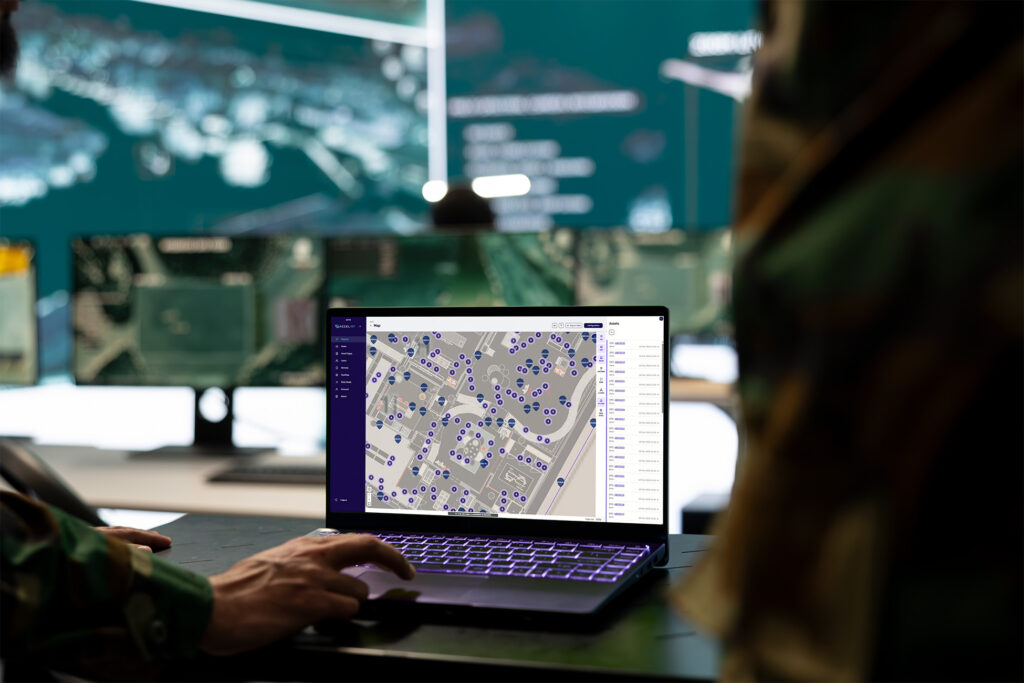
RTLS stands for real time location system.
It is not one single technology. It is a category of systems that track the live or near-live location of assets, people, vehicles, tools, containers, or equipment.
RTLS can use different signal types and methods, including RFID, BLE, GPS, Wi-Fi, UWB, 5G, and sensor fusion. The right method depends on the environment, asset type, accuracy target, cost, and workflow.
RTLS asset tracking is best when teams need to reduce search time, monitor movement, and see location changes across a space.
Common RTLS use cases include:
- Finding tools or mobile equipment in large facilities
- Tracking work in process across manufacturing zones
- Locating vehicles, trailers, racks, or containers in yards
- Monitoring high-value assets in data centers or secure sites
- Feeding live location data into dashboards and alerts
- Supporting safety or personnel visibility workflows where appropriate
Warehouse RTLS does not always mean every carton needs a pinpoint coordinate. Often, the real need is to locate high-value assets, reusable containers, mobile equipment, racks, or time-sensitive work.
RTLS also has tradeoffs.
It can require more system design. It may need more infrastructure. Some systems use active tags, which can add cost and battery management. Precision also depends on the facility, signal behavior, tag placement, and software model.
Acceliot’s AEP includes RTLS logic that blends signal processing, sensor fusion, and predictive modeling to estimate X and Y asset location. AVP can then turn that edge data into reports, rules, dashboards, and enterprise workflows.
Where RFID vs RTLS gets misunderstood
RFID vs RTLS often gets framed as a simple contest, but that is the wrong lens to look at it from.
RFID is not automatically real-time visibility by itself. RTLS is not always needed for every asset. More reads do not always mean better data. And replacing barcode scans does not automatically create an asset visibility strategy.
The deeper issue is business accuracy.
Can the system tell the operation what happened in a way the business can trust?
Many teams do not need continuous coordinates for every asset. They need verified events:
- Received
- Staged
- Loaded
- Shipped
- Returned
- Removed
- Placed in a cabinet
- Moved to rework
- Sent to the wrong zone

For those workflows, RFID with strong edge filtering may be the right fit.
Other teams do need live location. A manufacturer may need to find a fixture quickly. A logistics team may need to track containers across a yard. A data center may need cabinet-level or zone-level visibility. A defense operation may need stronger accountability for controlled assets.
| Operational need | Better fit | Why |
| Confirm inbound and outbound shipments | RFID | Strong for dock, gate, and portal events |
| Know which zone holds an asset | RFID or RTLS | Depends on precision needs |
| Find one tool in a large facility | RTLS | Live location can cut search time |
| Track every item through a chokepoint | RFID with edge filtering | Strong for high-volume movement checks |
| Monitor WIP flow across production | RFID RTLS | Combines event reads and location context |
| Track assets across yards or lots | RTLS or hybrid | Location changes across broad spaces |
| Reduce manual cycle counts | RFID | Strong fit for inventory automation |
| Feed dashboards and enterprise systems | RFID RTLS software | Software turns reads into decisions |
The answer is rarely just the tag.
It is the whole system behind the tag.
How to choose the right RFID RTLS strategy
A good RFID RTLS strategy starts with the asset and the decision it supports.
Before choosing a technology, map the workflow. Where does the asset start? Where does it move? Where does the data become useful? What system needs the update?
Use these questions to narrow the decision:
- What assets need to be tracked?
- Are they moving, stationary, or both?
- Do you need identity, location, condition, or all three?
- Do you need zone-level, chokepoint-level, or X and Y location?
- How dense is the environment?
- Are there metal racks, vehicles, liquids, or RF reflections?
- Do you need real-time alerts or scheduled reports?
- What systems need the data, such as WMS, ERP, MES, TMS, YMS, DCIM, or analytics tools?
- What data must be trusted enough to automate work?
- Will the system need to scale across sites?
This is where Acceliot’s full-stack approach matters.
Acceliot combines RFID hardware, RTLS software, edge intelligence, AVP, AEP, Smart Space Portal, dashboards, sensor fusion, and enterprise integration services. That lets teams match the sensing method to the operational problem instead of forcing every use case into one model.
For a dock door, the answer may be RFID with AI-powered filtering. For a yard, it may be RTLS. For a plant, it may be both.
The best asset tracking system is not the one with the most reads, it is the one that gives the operation data it can act on.
FAQs about RTLS vs RFID
What is the main difference between RTLS and RFID?
RFID identifies tagged assets when they are detected by readers and antennas. RTLS tracks the live or near-live location of assets across a defined space. RFID is often used for identity, inventory, and movement events. RTLS is used when teams need more active location visibility.
Is RFID the same as RTLS?
No. RFID is a technology used to identify tagged assets. RTLS is a system category used to locate assets in real time. Some RTLS systems can use RFID, but RTLS may also use BLE, GPS, Wi-Fi, UWB, 5G, or sensor fusion.
Can RFID be used for real-time location tracking?
Yes, RFID can support real-time or near-real-time location tracking when it is paired with the right reader layout, antenna design, edge processing, and software. Basic RFID reads alone are not enough. The system must turn those reads into trusted location or movement events.
When should a warehouse use RTLS instead of RFID?
A warehouse should look at RTLS when it needs live location for assets such as tools, racks, vehicles, containers, mobile equipment, or high-value inventory. If the main goal is dock validation, inventory checks, or zone reads, RFID may be the better fit.
What is RFID RTLS?
RFID RTLS is a combined approach that uses RFID data as part of a real-time location or asset visibility system. It can help teams identify assets, track movement, apply location logic, filter noisy reads, and send trusted data to dashboards or enterprise systems.
What is more accurate, RFID or RTLS?
Accuracy depends on the use case. RFID can be highly accurate for asset identity and checkpoint events when designed well. RTLS is usually better when the operation needs live location or X and Y positioning. The best result often comes from matching the technology to the workflow.